
Gross National Happiness
Bhutan's development philosophy, and since 2010 a national mandate in education. Wellbeing and human flourishing at the center of what progress means, rather than at its margins.
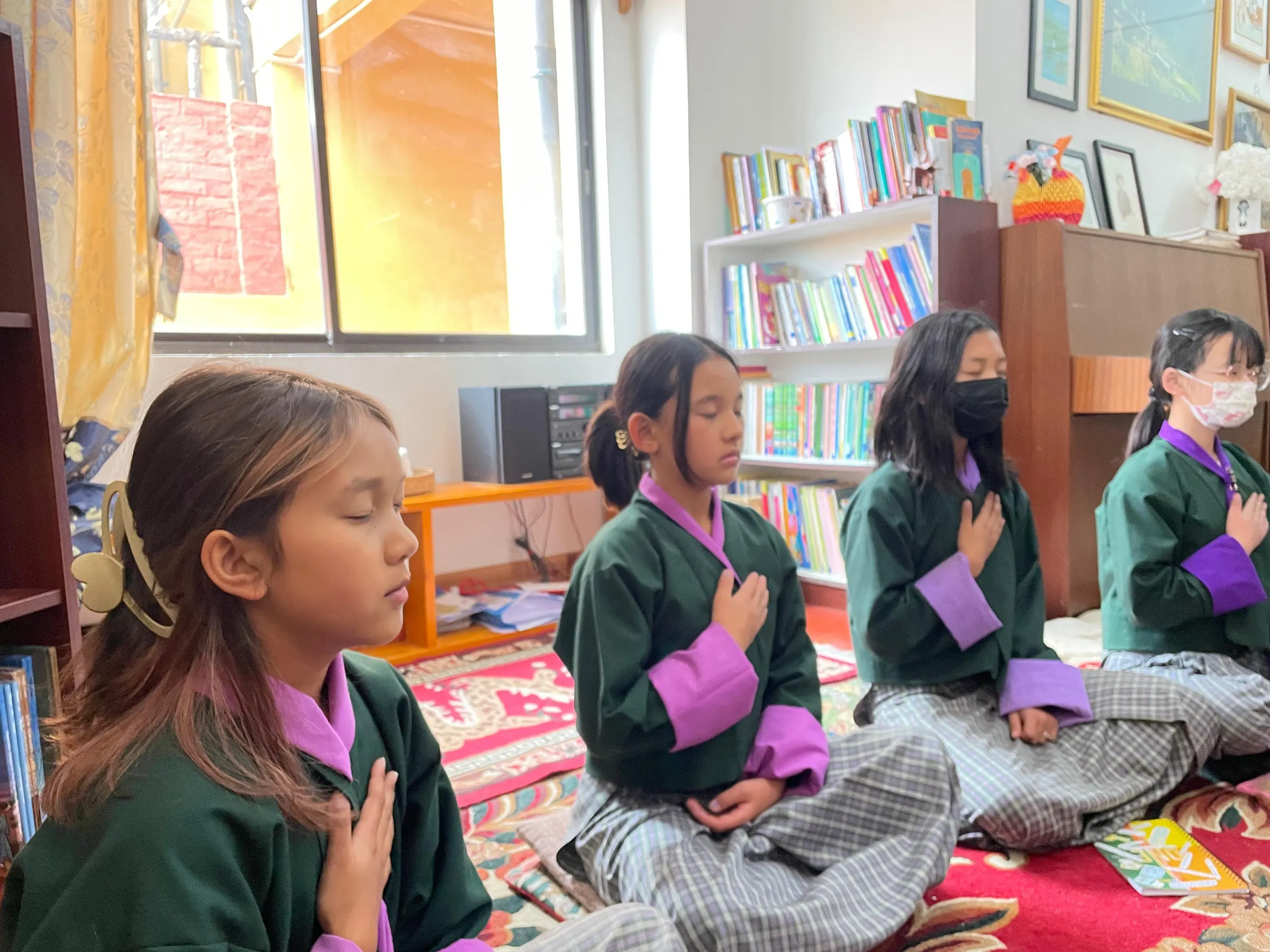
When students feel well, they do well.
Wellbeing at ELC is not a period on the timetable. It is how the school is built, and it runs through every hour of the day.
The case
Our learners are growing up amid the lasting effects of a pandemic, rapid technological and AI-driven change, social media and constant comparison, academic pressure, family migration and separation, substance use including vaping, bullying and cyberbullying, and rising anxiety and loneliness.
These are not abstractions. They arrive at our gate every morning in the hearts of our children.
A school can respond to this in one of two ways. It can add a wellbeing period and a counselor and hope the rest of the timetable does no harm. Or it can accept that the way a school treats children all day is the wellbeing program, and build accordingly. ELC has taken the second path for more than twenty-five years.
The evidence supports it. A 2023 review of 424 studies found that students who take part in mindfulness and social-emotional learning programs perform better in the classroom, with significantly improved executive function, learning attitudes and academic achievement. Closer to home, a 2021 study of 367 secondary students in Trashigang found that teachers and students alike observed improved concentration and calmer minds. Internationally, the OECD's PISA framework now measures student wellbeing, engagement, belonging and life satisfaction alongside literacy and numeracy.
None of which is why we do it. We do it because a child who is anxious, unseen or carrying an unresolved hurt cannot learn, and because being well is worth wanting for its own sake.
Where this comes from
Our practice draws on six sources. Three are Bhutanese and centuries old. Three are contemporary and international. They agree with each other more than one might expect.
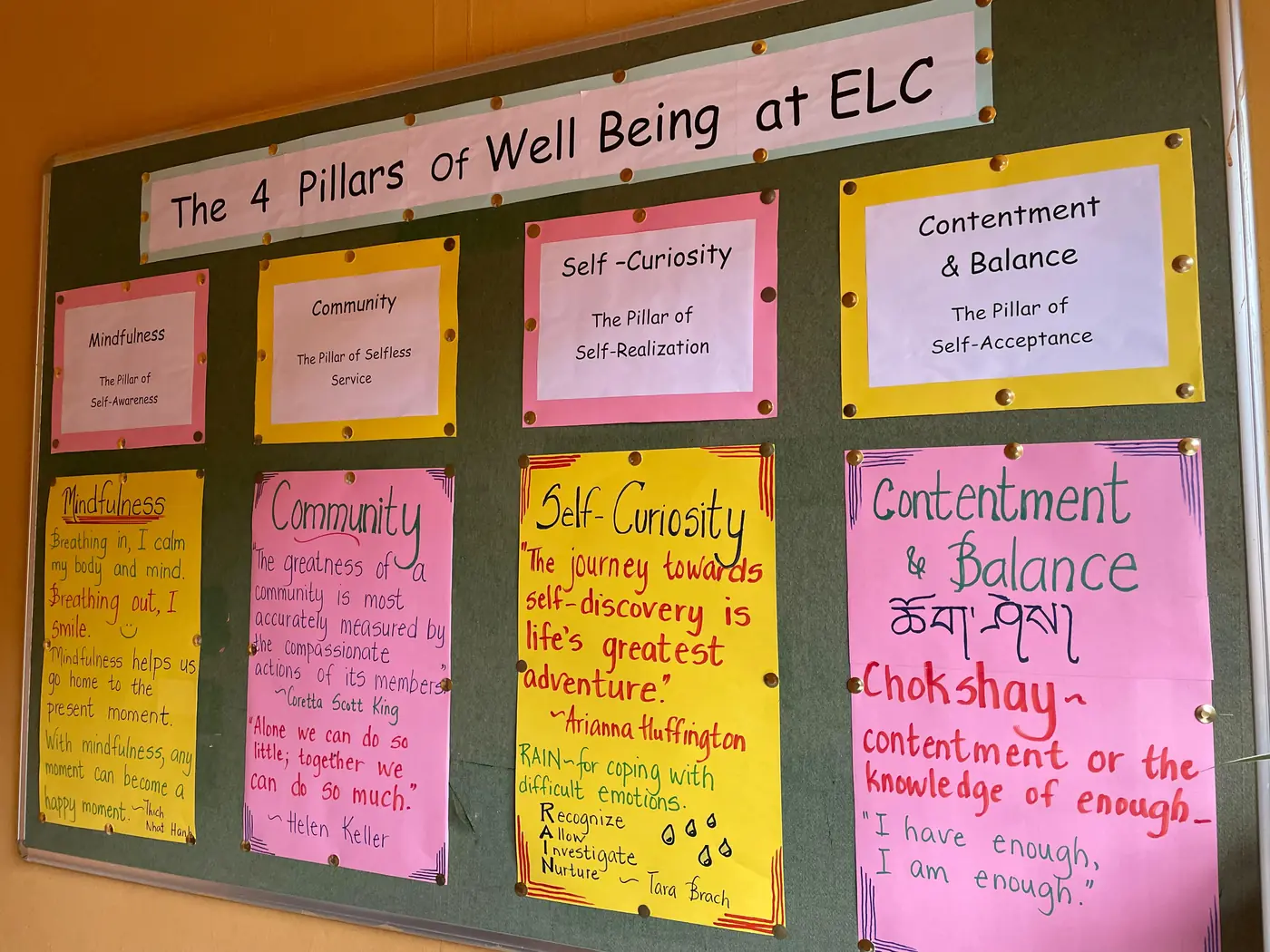
Bhutan's development philosophy, and since 2010 a national mandate in education. Wellbeing and human flourishing at the center of what progress means, rather than at its margins.
Loving kindness, compassion, sympathetic joy and equanimity. Including equanimity amidst the eight worldly winds: gain and loss, fame and disrepute, praise and blame, pleasure and pain.
Bhutan's traditional practice of community mediation, which holds that it is better to lose in the village than to win in the court of law. The origin of our restorative approach.
The Contentment Foundation's framework: Mindfulness, Community, Self-Curiosity, and Contentment and Balance. ELC was the first school in Bhutan to adopt it, in 2019.
The Mind and Life Institute's framework, with its three modes of care: receiving care, self-care, and extending care. Children who have been cared for learn to care.
FEEL, IMAGINE, DO, SHARE, and the I CAN mindset. Wellbeing is not only inward. A child who believes they can change something is a child who is well.
Core program 1 of 5
Student wellbeing at ELC is not one lesson. It is a set of practices that recur through every day and every week, so that emotional skill is built the way any other skill is built: by repetition, in company, over years.
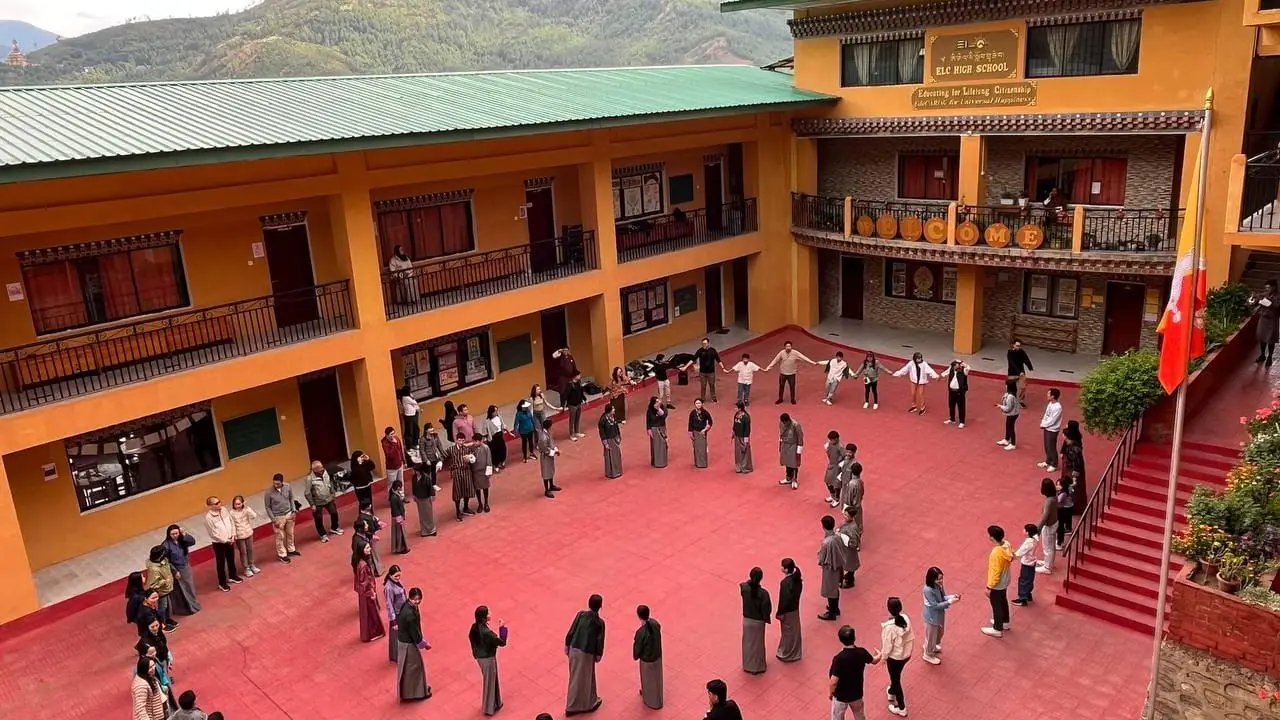
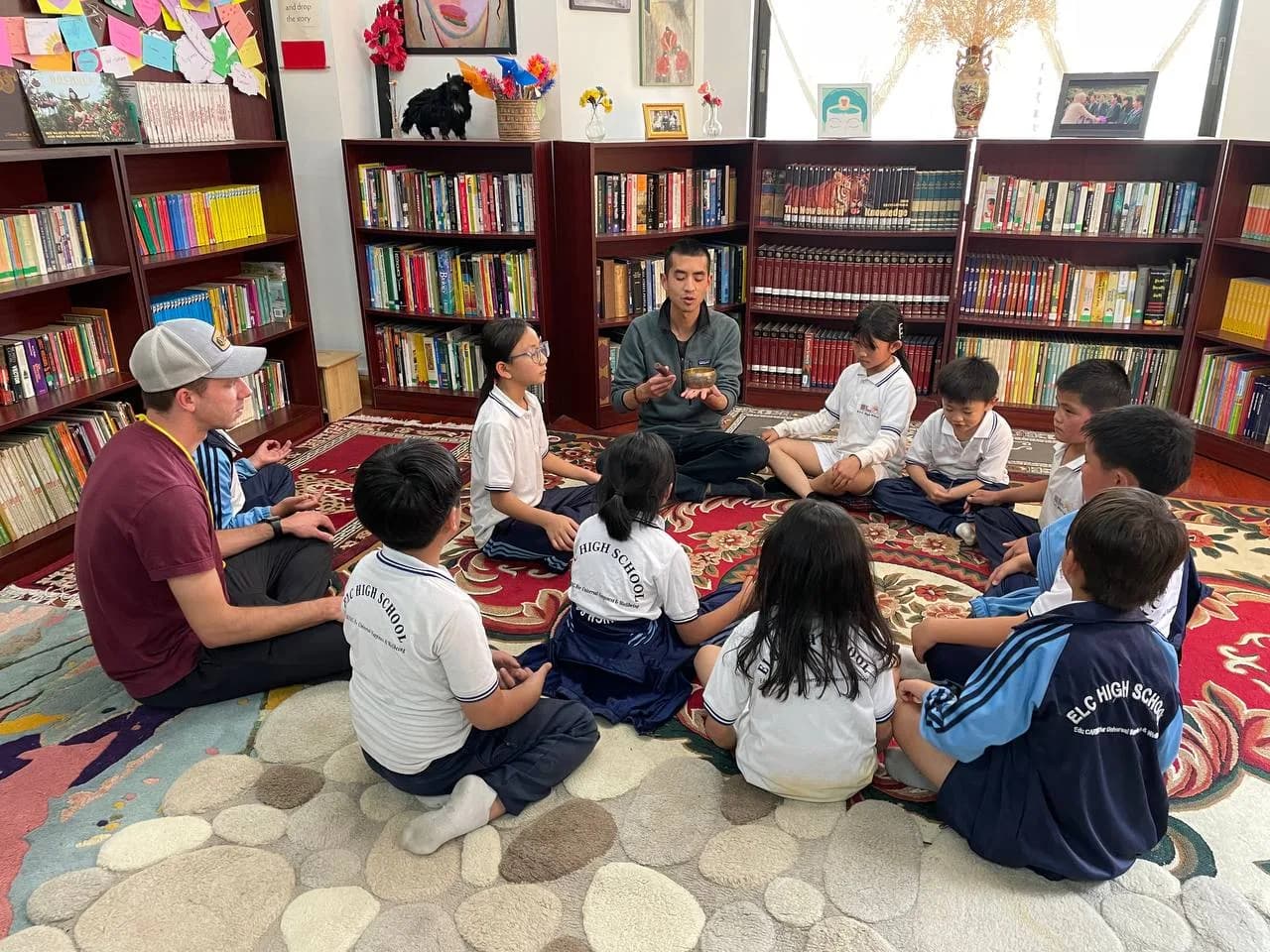
At the top of every hour, a gong sounds across the school. Everyone stops, whatever they are doing, and takes one conscious breath together. Students, teachers, visitors, the principal. It lasts a minute.
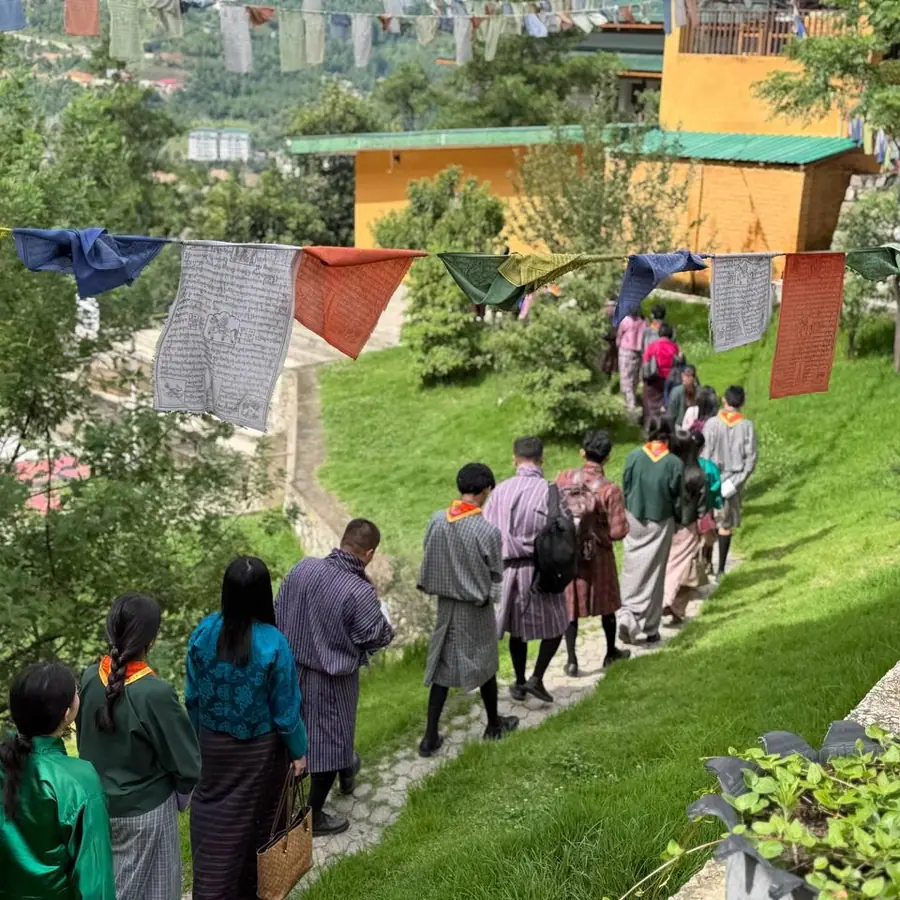
Educators and students also begin every period, class and examination with a mindful moment. ResLIFE students take a mindful walk each morning. As one of our students puts it: it is about how powerful the mind can be, and in exams a few deep breaths genuinely help.
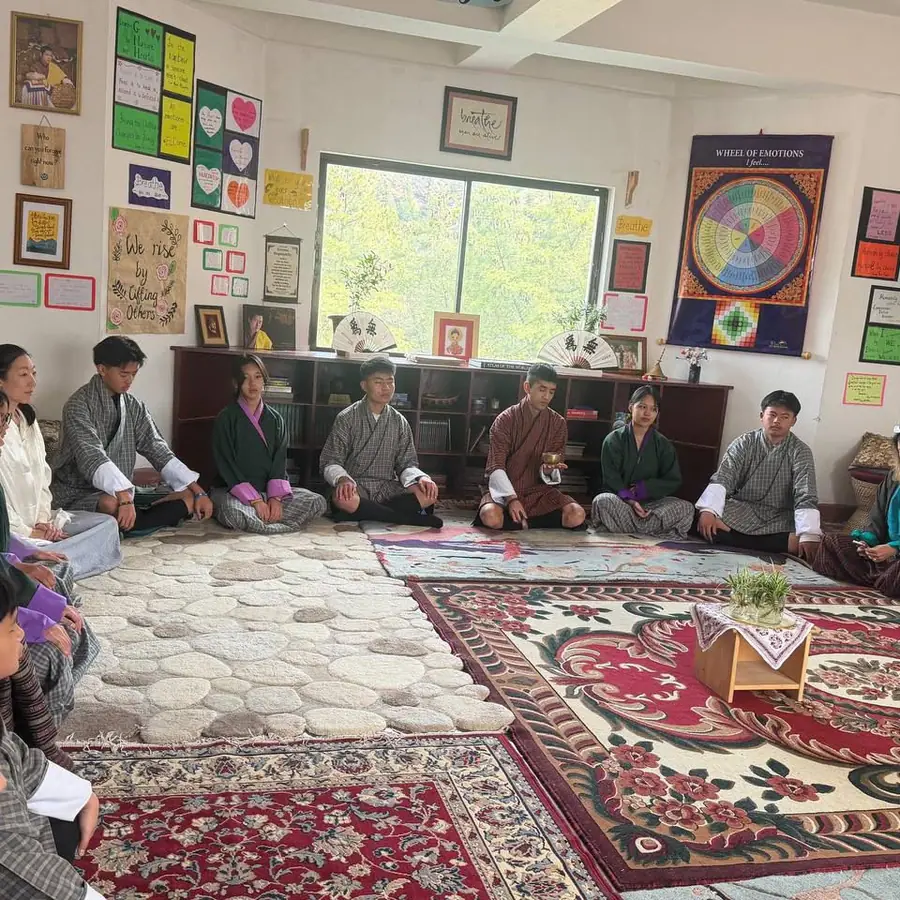
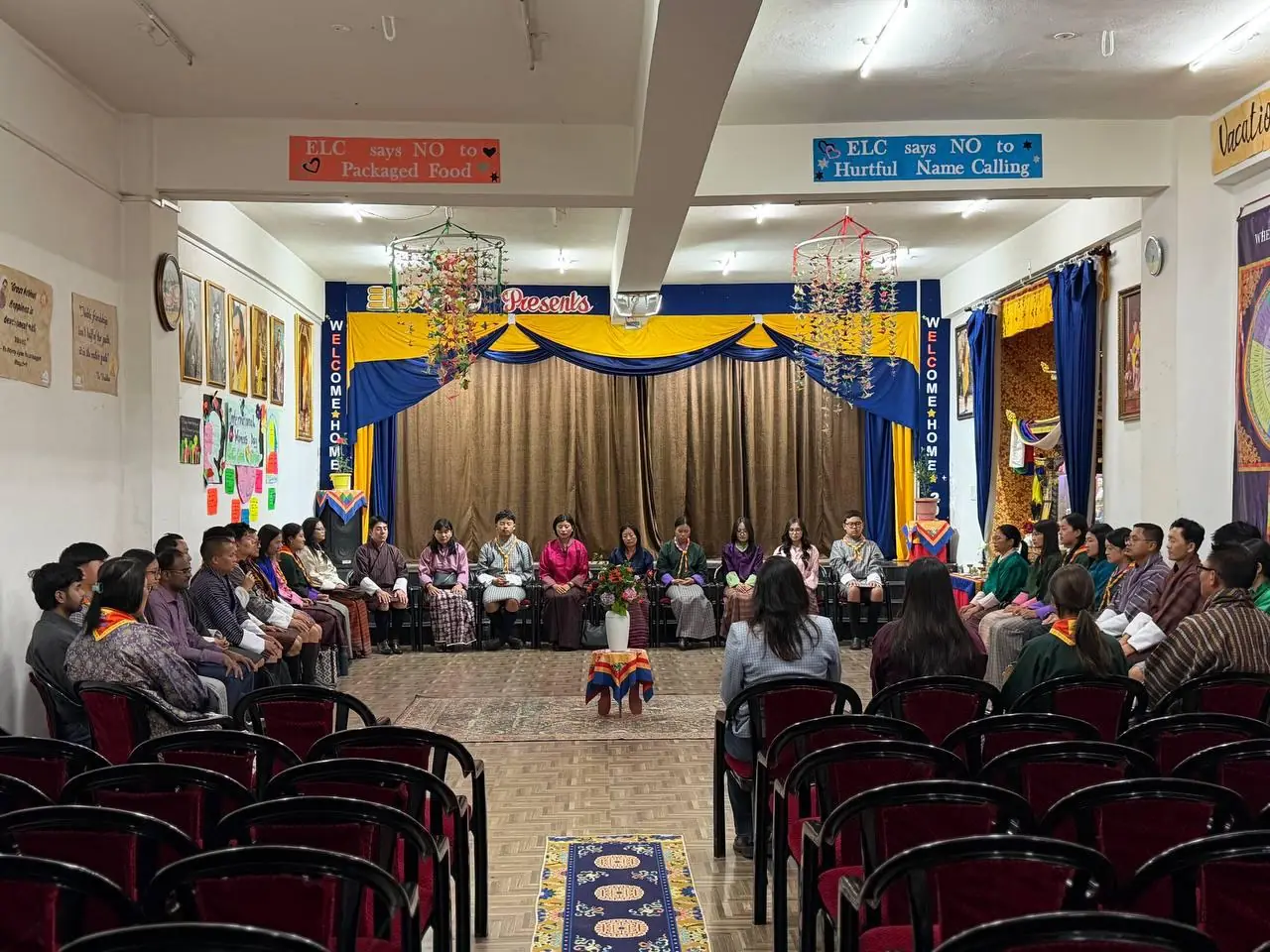
Each grade meets weekly in a circle with their homeroom teacher, and regularly with the Principal and the school's wellbeing focal. The circles follow the Four Pillars of Wellbeing curriculum and ask direct questions: what is your inner weather today, what are you grateful for, what are you worried about, what are you hoping for.
The circle is where children learn that their inner life is speakable. That is the whole point of it.
Thirty minutes each morning in the home room, with the teacher as facilitator rather than instructor: student voice and choice, problem-solving, and social-emotional learning. It is the daily counterpart to the weekly circle.
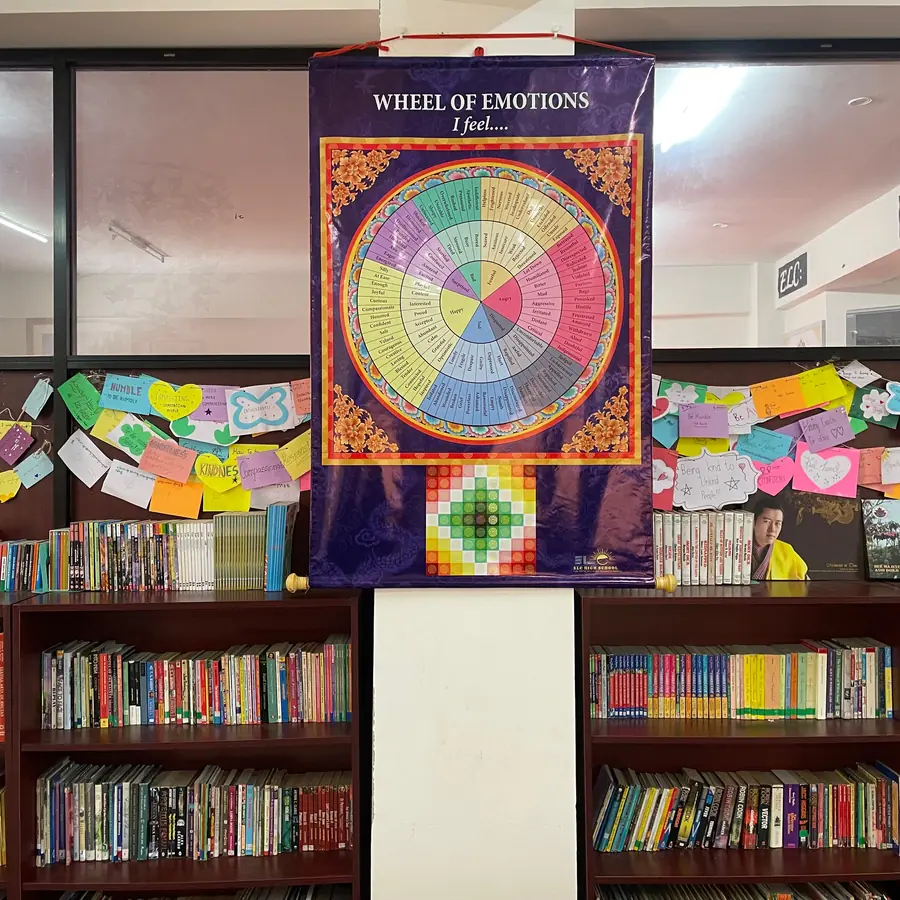
Emotion check-ins, the Thangka Wheel of Emotions, emotion mantras, and letters of gratitude written to our own emotions. Children learn to name what they feel, and to welcome all of it with self-compassion, including the feelings we usually push away. Not all behaviors are acceptable. All emotions are.
A short weekly practice shared with every teacher, in four movements. BREATHE: a mindful moment to settle and arrive. FEEL: an emotions check-in to build self-awareness. SHARE: a reflection prompt for a circle or a journal. ACT: a practice that carries the learning into action.
Micropractices exist because teachers are busy. They are deliberately small, so that wellbeing is something a teacher can actually do on a Tuesday rather than another program to be delivered.
Children keep journals and are taught to be curious about their own inner lives rather than merely to manage them. Self-curiosity is one of the Four Pillars, and it is the pillar that lasts longest into adulthood.
Every student at ELC has a teacher mentor. Not a form tutor who takes a register, but an adult whose responsibility is to know that child: to notice a change, to ask, and to stay with them through whatever is happening. This is the single most protective thing a school can offer, and it is why we do it for every child rather than only for those already in difficulty.
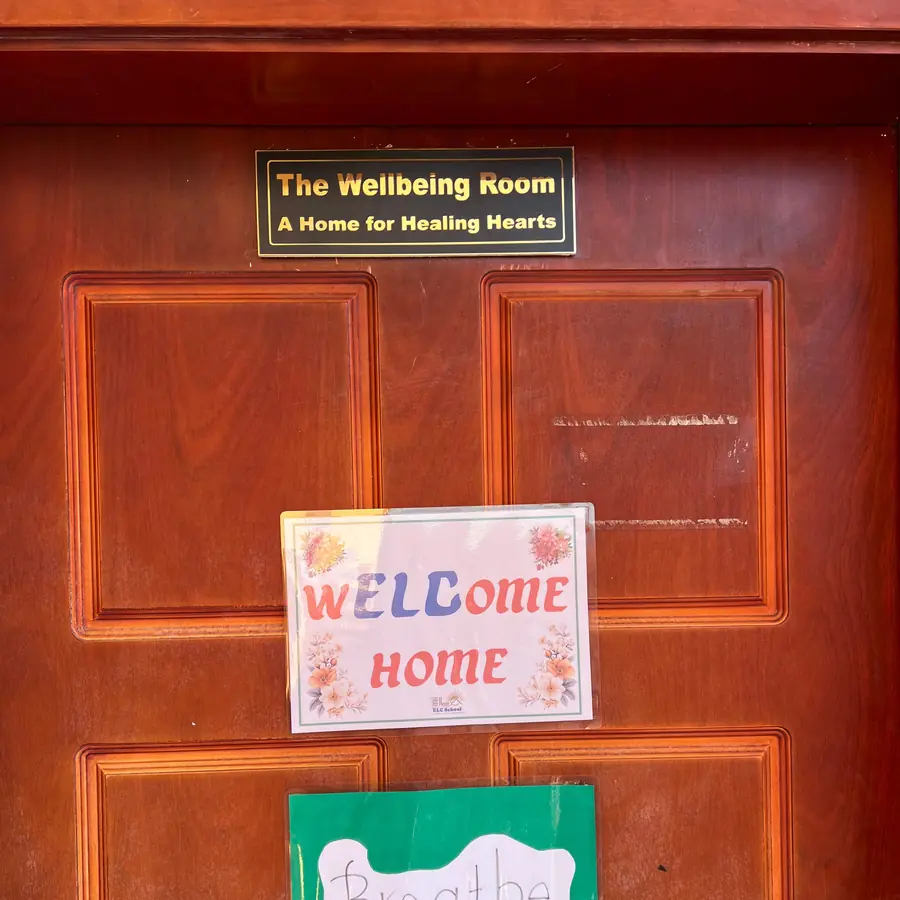
During examinations and other periods of high stress, we open a dedicated wellbeing space in the school. Somewhere to sit, breathe, and be met by someone unhurried.
Core program 2 of 5
Most school wellbeing programs begin with students. ELC began with adults, and still does. Children learn wellbeing far more from what is modeled than from what is taught, and a school cannot ask exhausted teachers to cultivate calm in others.
Wellbeing is the non-negotiable subject every school should have. It's been a gift that our children have the language to name what they feel. They will be a force of good, not just for themselves, but for the world.
Core program 3 of 5
A child spends more hours at home than at school. A wellbeing program that stops at the gate is only half a program.
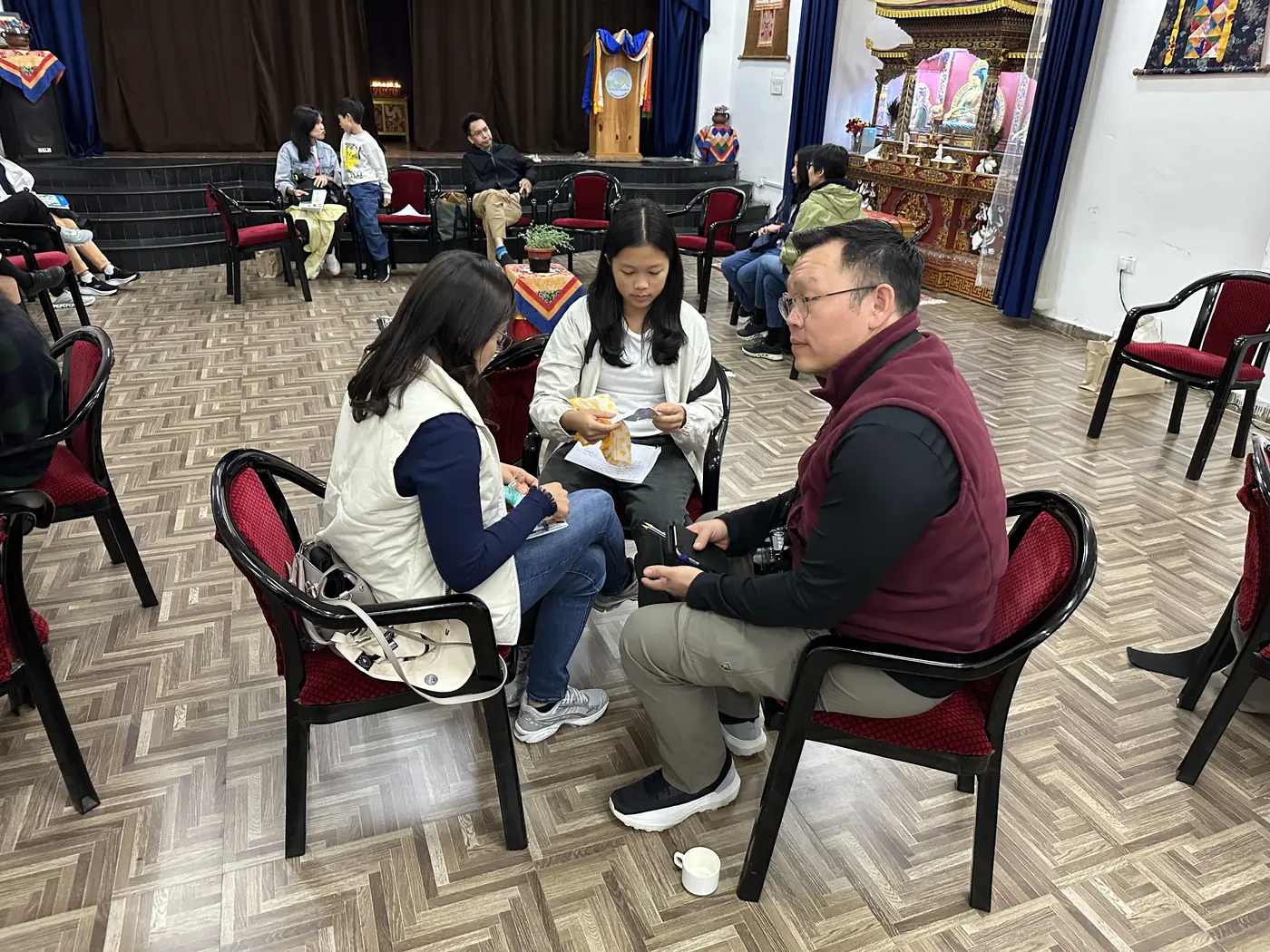
Each term we gather parents, guardians and caregivers in the same kind of circle their children sit in. We ask what is joyful about parenting and what is genuinely difficult, and what practices sustain them. Parents discover, usually with some relief, that the others in the room find it hard too.
Children and parents exchange handwritten letters of gratitude. Love goes without saying in our families, but it ought to be said anyway.
Sessions on adolescent mental health, screen and social media use, vaping, and cyberbullying. Practical, current, and specific to what Bhutanese families are actually navigating.
Where a restorative conference involves a child's family, parents take part in the circle rather than being informed of an outcome afterwards. In ResLIFE, a parent meeting precedes each residential cycle, and weekend family time is protected.
Core program 4 of 5
Our approach to conflict and harm has two halves. The first is preventing it. The second is repairing it. Punishment comes a distant third, and rarely.
Almost everything that later needs putting right begins in an unattended moment: a corridor between periods, the far corner of the playing field, the queue at the dining hall, the quiet half hour in a hostel wing.
A named Teacher on Duty is rostered for every session, break, meal, games period and ResLIFE evening, and the roster is published each term so children and parents know who is available. The Teacher on Duty is not a supervisor watching from a distance. They walk where the children walk, join the game, sit at the table, ask how the weekend was.
Duty teachers give particular attention to the places children themselves name as unsafe, stressful or lonely, and to the moments when a child is alone who would usually be with friends. Concerns are passed the same day to the class teacher or the wellbeing focal, so that a small worry is addressed before it becomes an incident. A briefing opens each duty and a handover note closes it, so care carries across the day rather than resetting with each shift.
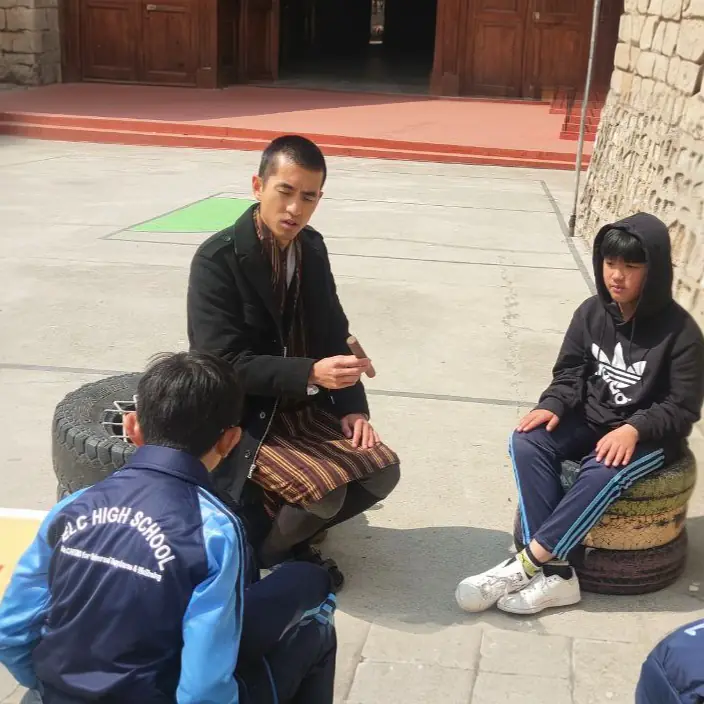
Supervision asks whether anything has gone wrong. Presence asks how each child is doing. The measure of a good duty is how many children were spoken with, not how many were corrected.
Where prevention has not been enough, we sit down together. A restorative circle treats misbehavior as a learning opportunity rather than simply a problem, and gives everyone a voice rather than imposing authority from the top down.
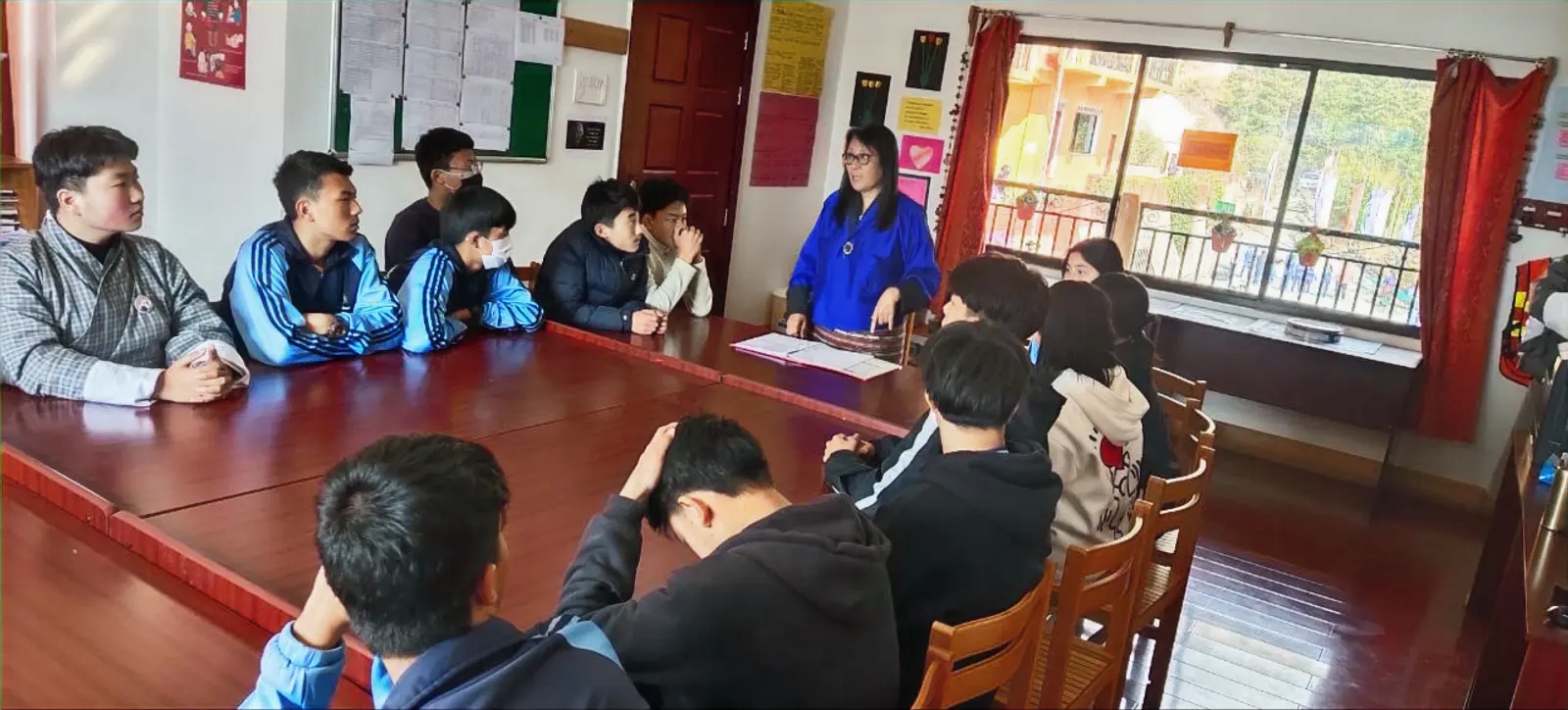
Classroom circles for the ordinary friction of a school week. Referral circles where something needs more time. Formal conferences involving parents and school leadership. And student-led circles, because children who have sat in enough circles can run them.
ELC's own Anti-Bullying Interventions procedure follows national Ministry guidance. It works because of everything above it: a procedure only functions when children believe there is an adult present who will listen.
ELC is working with the Jigme Singye Wangchuck School of Law and the Contentment Foundation to train educators and develop a restorative justice manual for the Ministry of Education and Skills Development, so that this approach is available to schools across Bhutan.
To be human is a flowing circle of rupture, repair and restoration. The aim of a circle is not to establish guilt but to mend a relationship, so that the child who sits down to a lesson the next morning is no longer carrying an unresolved hurt.
Core program 5 of 5
A child who believes they can change something is a child who is well. Design for Change is where our wellbeing program turns outward, from how a child feels to what a child can do.
Feel
a problem that genuinely bothers you
Imagine
a solution
Do
it
Share
the story of what changed
Every class and grade at ELC undertakes a project, from pre-primary to Class 10, with younger children supported more closely and older ones leading their own work.
ELC is the Design for Change country partner for Bhutan, and our Founding Principal is its Founding Country Lead. Since 2010, DFC Bhutan has reached more than 400 schools across all 20 districts, empowering thousands of children to change their communities for the better. The approach has since been carried into the national Scouts curriculum in schools across the country.
Two of these came directly out of wellbeing work. A school that teaches children to name hurt should not be surprised when they decide to do something about it.
One project, done properly, touches all four pillars of Gross National Happiness. When a class replaces plastic fencing with locally made bamboo, they exercise good governance by taking ownership of a problem, sustainable development by using local materials and skills, environmental conservation by choosing what will not outlive them, and cultural preservation by valuing a technique their grandparents knew.
Beyond the five
If wellbeing only happened during wellbeing, it would not be working. These are the places it shows up in the rest of school life.
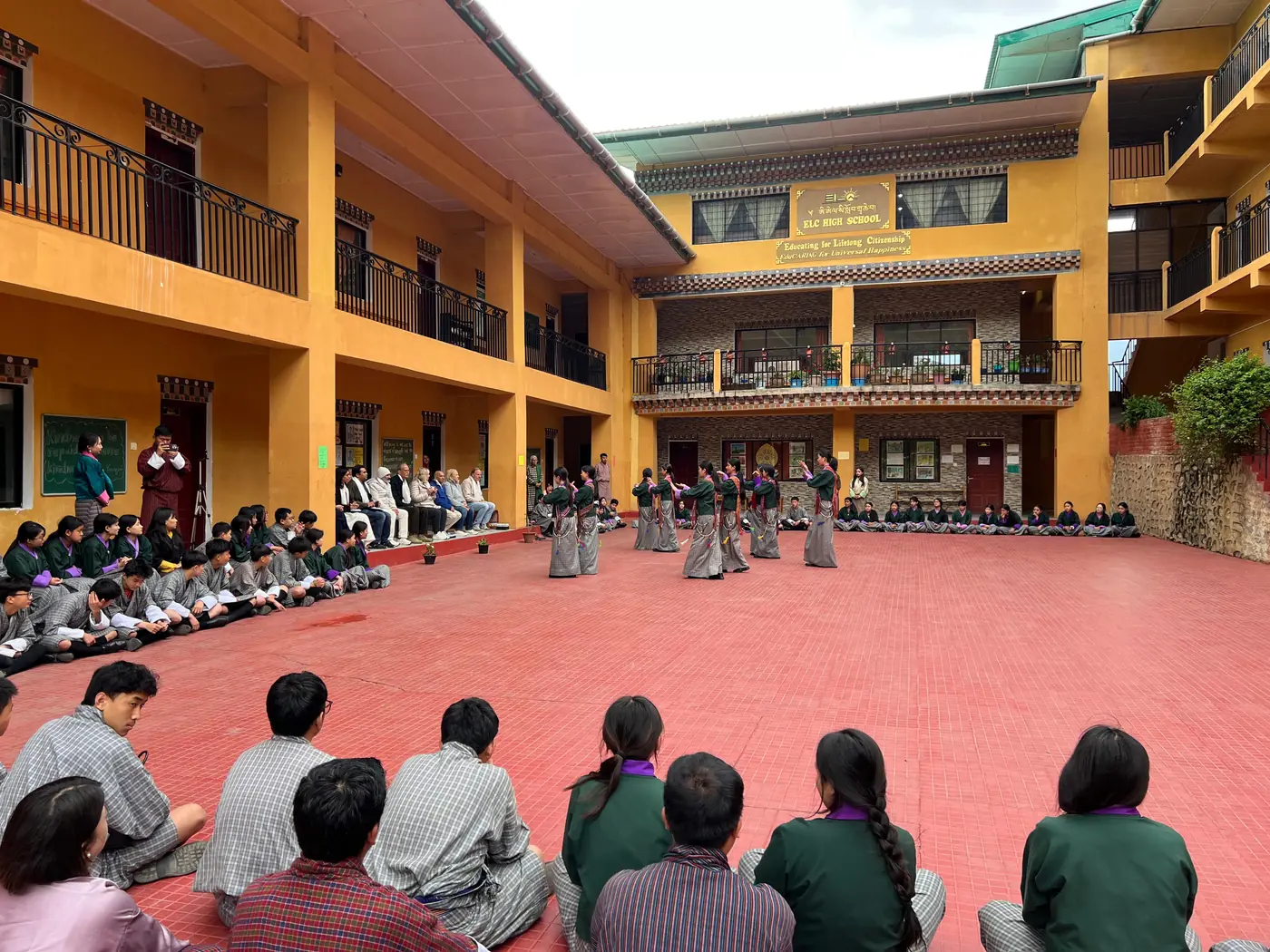
A thirty-minute whole-school gathering each Wednesday to celebrate what has gone well, raise what has not, and watch what students have made, with the audience expected to respond thoughtfully. As we say here: when we extend care to others and share those stories, we all grow Smart Hearts.
Our residential living-learning community, modeled on the traditional Bhutanese home. Mindfulness in the morning, academics in the day, sport and service in the afternoon, and a protected half hour of caregiver quality time each evening in which an adult sits with children without agenda. It is often in that half hour that a child finally says what has been on their mind.
We treat assessment first as an opportunity to encourage, support and improve learning, not as an instrument of ranking. Descriptive, strength-based feedback and self- and peer-assessment, with less public comparison of marks and less labeling of children by their results. How a school assesses is a wellbeing decision, whether or not it is recognized as one.
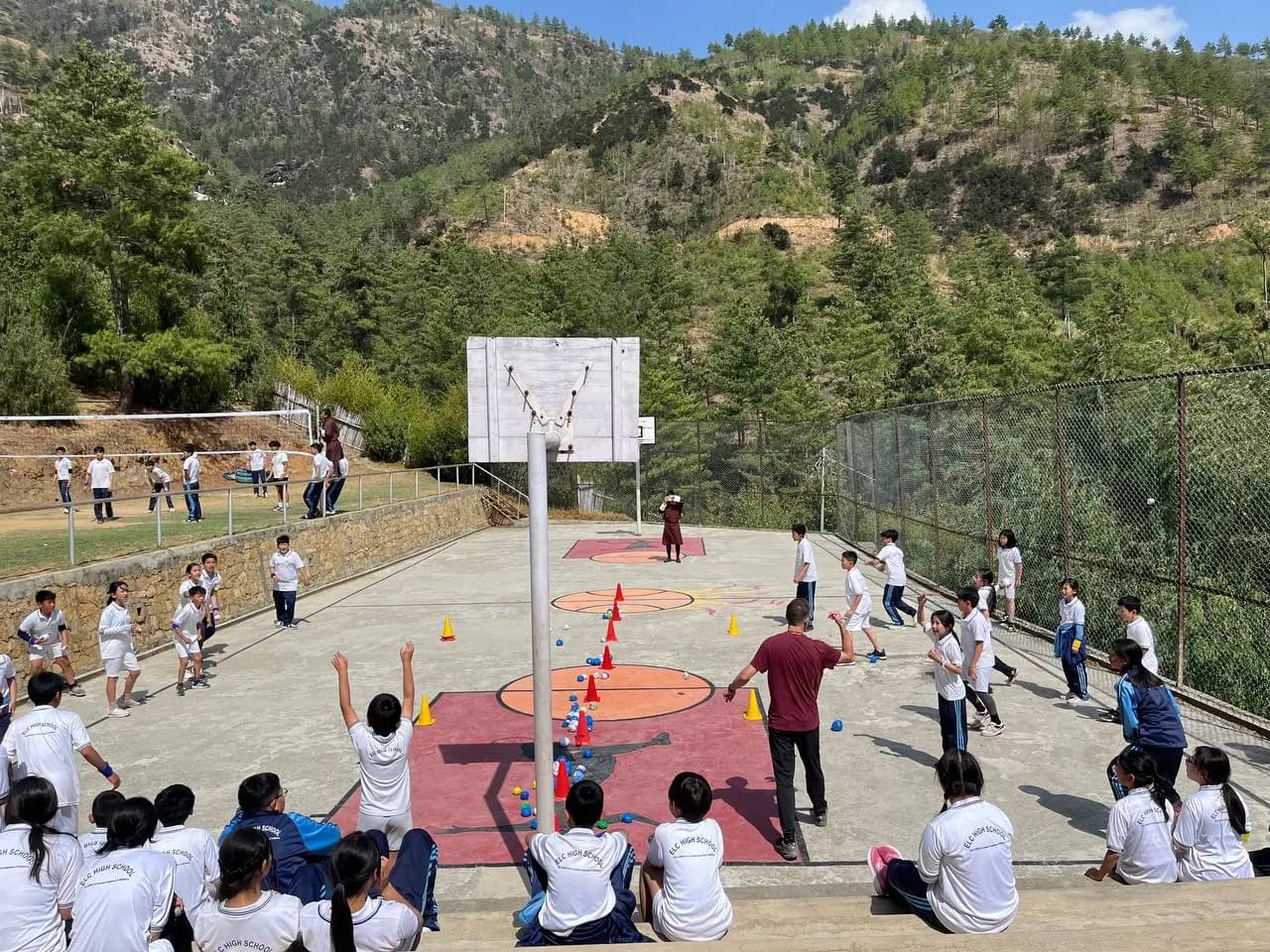
Organized around sportsmanship, enjoyment, teamwork and full participation rather than competition. Every learner takes part in at least one activity, and recognition goes to fair play, effort and improvement as readily as to winning.
Peer tutoring, buddy systems, group problem-solving and collaborative projects, with collective progress recognized alongside individual achievement, so that a classmate's success is experienced as a shared good rather than a personal loss.
Student leader elections run along Election Commission of Bhutan guidelines. Candidates learn that even if one loses an election, one need not lose the more important lesson.
Project Helping Hands for Health and Happiness, in partnership with the Bhutan Kidney Foundation, on the conviction that helping others is a social responsibility rather than charity. Young Ambassadors of Change, bringing rural and urban Bhutanese children together through travel and home stays. And Inclusive Education, on the principle that a GNH society is one where every individual lives with dignity and self-determination.
A full day given to the many ways a child can be intelligent: performing arts, physical education, visual arts and crafts, film-making and literacy. Every child finds something they are good at, which is not a luxury but the foundation of a willingness to try.
Only Connect
ELC does not run a wellbeing program alongside its other programs. It runs one program, and wellbeing is the thread that joins every part of it.
Listed separately, everything on this page can look like a long catalog of activities. Understood properly it is one thing seen from different angles.
Sport connects to belonging. Assessment connects to self-worth. A restorative circle connects to a mathematics lesson the following morning, because the child in that lesson is no longer carrying an unresolved hurt. The Teacher on Duty in the corridor connects to the wellbeing focal's caseload, because presence prevents what would otherwise need repair.
The risk in any school is that wellbeing becomes a period on the timetable, a workshop in February, or a form to be filed. Our commitment is the opposite: that a child cannot tell where our wellbeing work ends and the rest of school begins.
Who we work with
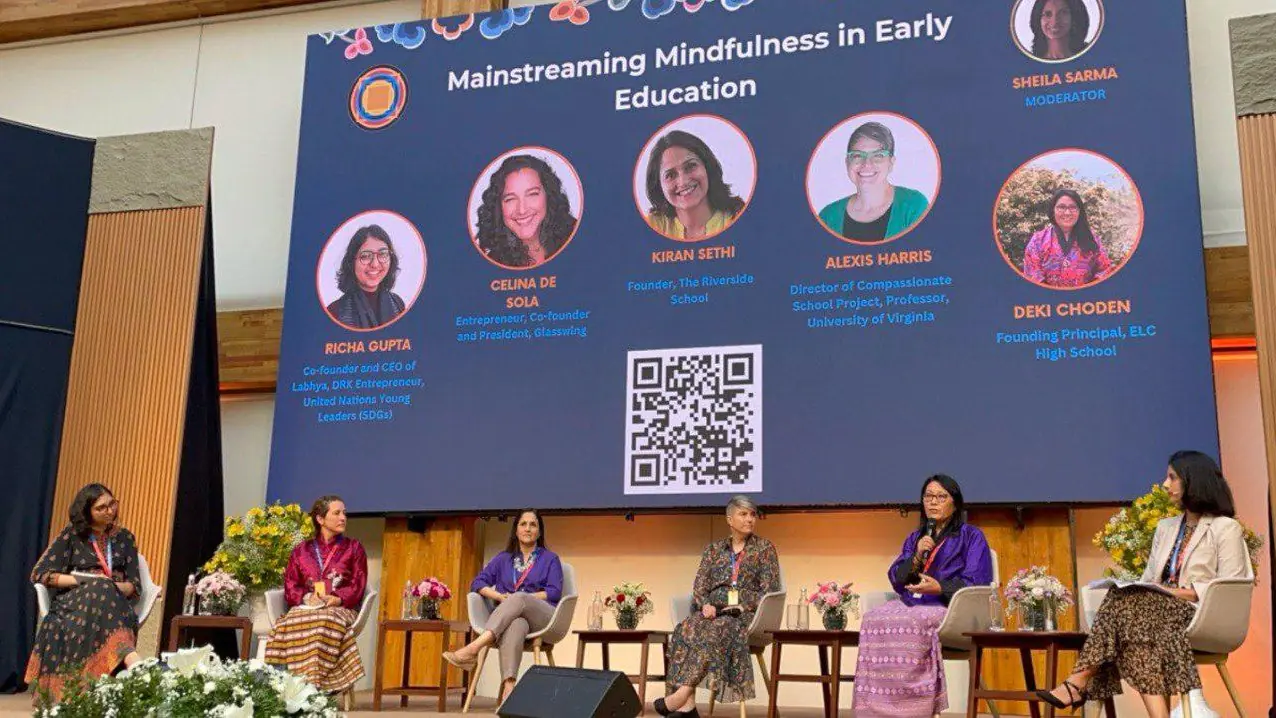
We have never claimed to have worked this out alone. Everything on this page has been shaped by people who knew more than we did, and much of it has since traveled further than we expected.
International
ELC is the country partner for Design for Change in Bhutan, and founded DFC Bhutan in 2010.
It has since reached over 400 schools in all 20 districts, and its approach has been carried into the national Scouts curriculum.
Connect with Our Team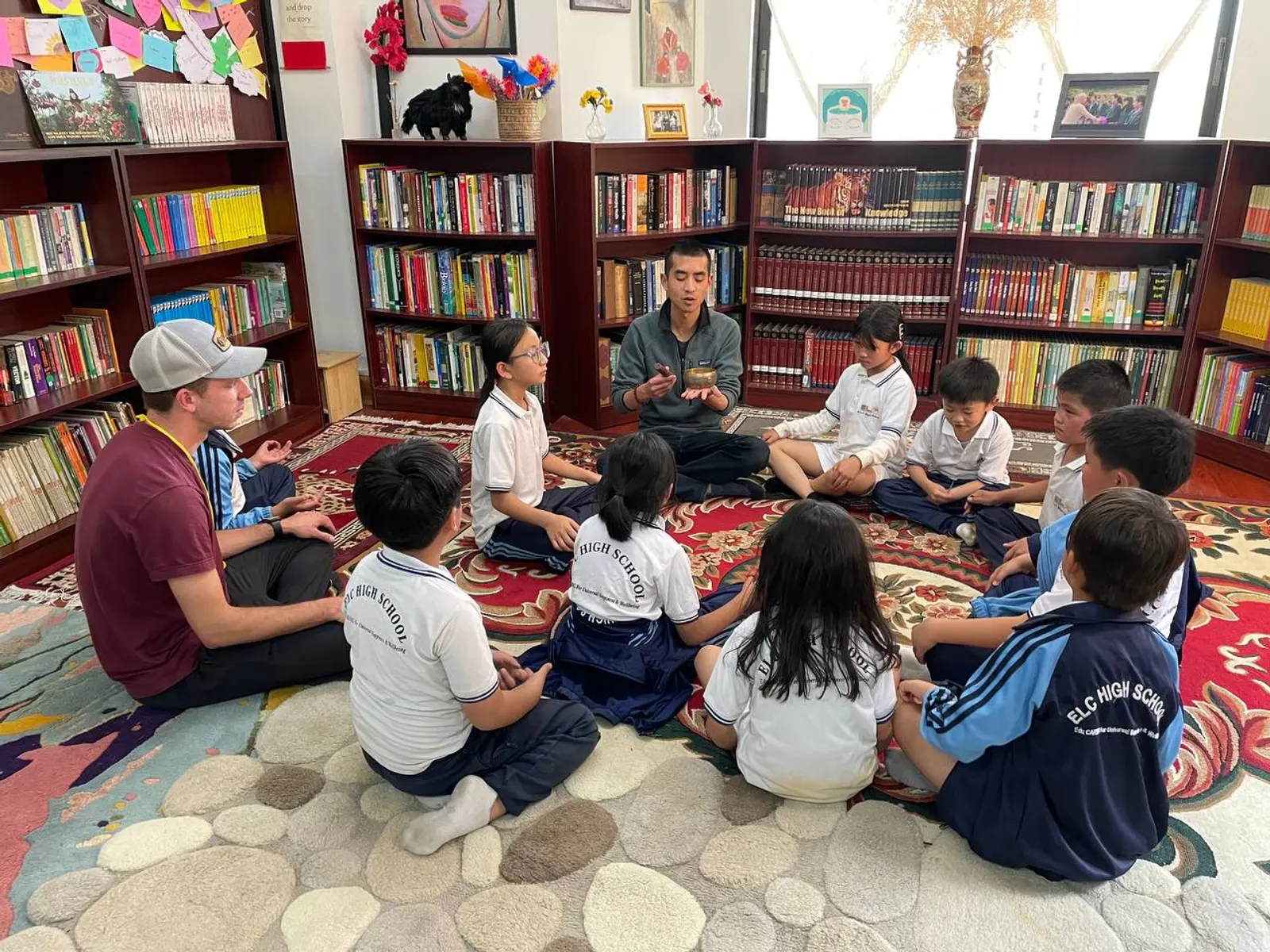
International
In 2019 ELC became the first school in Bhutan to adopt the Four Pillars of Wellbeing: Mindfulness, Community, Self-Curiosity, and Contentment and Balance.
We began with the adults rather than the children, and the practices grew into a culture rather than a curriculum.
The Contentment Foundation describes ELC as a lighthouse school: a place where the practices of wellbeing are not simply taught but lived throughout the culture of the school. Bhutanese scholars and practitioners, including Dr Dorji Wangchuk and Dr Karma Phuntsho, helped root the framework in our own language and traditions, so that the pillars came to be expressed through moelam, chokshay, nyingje and gatshor: intention, contentment, compassion and gratitude.
ELC now works alongside the Contentment Foundation Bhutan to share these practices with schools across the country, including annual retreats that have reached counselors from 141 schools.
Visit Contentment FoundationIn Bhutan
With JSW Law and the Contentment Foundation, ELC is training educators and developing a restorative justice manual for the Ministry of Education and Skills Development.
Connect with Our TeamInternational
A partnership on raising children who are kind, ethical and concerned for others as much as they are high-achieving.
Connect with Our TeamIn Bhutan
ELC works with Bhutan's teacher training institutions so that new teachers meet these practices before they meet their first class.
Paro College hosted the 2024 International Symposium on Re-imagining Education from a GNH Perspective, bringing together over 200 education leaders.
Connect with Our Team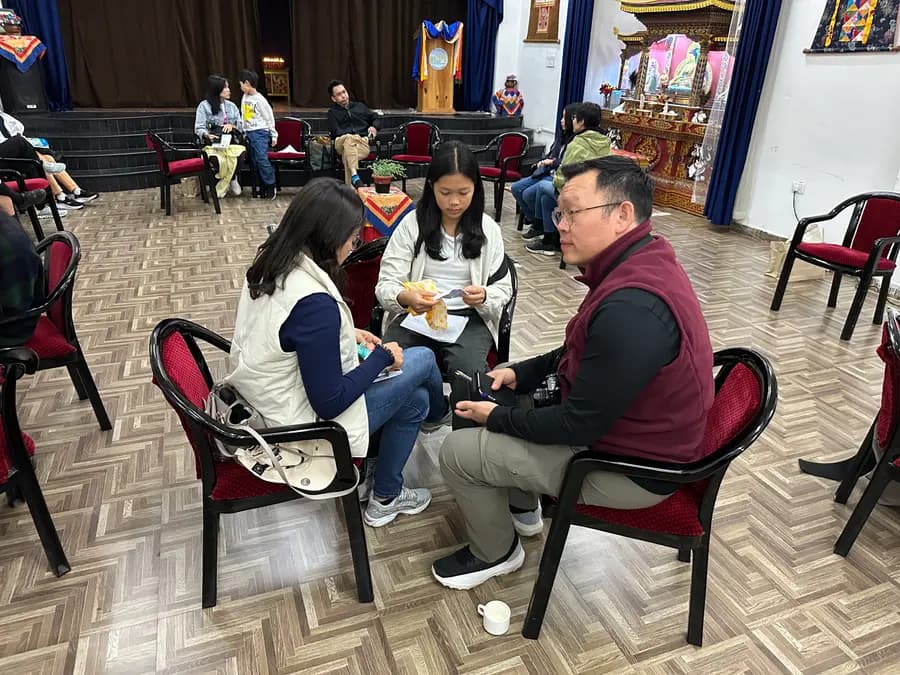
International
A Call to Care in Education, from His Holiness the Dalai Lama's Mind and Life Institute, gives us the three modes of care that run through our practice: receiving care, self-care, and extending care.
The initiative has been piloted in Bhutan with the GNH Centre.
Visit Mind and LifeInternational
ELC contributes to and learns from UNESCO's international framework for school happiness.
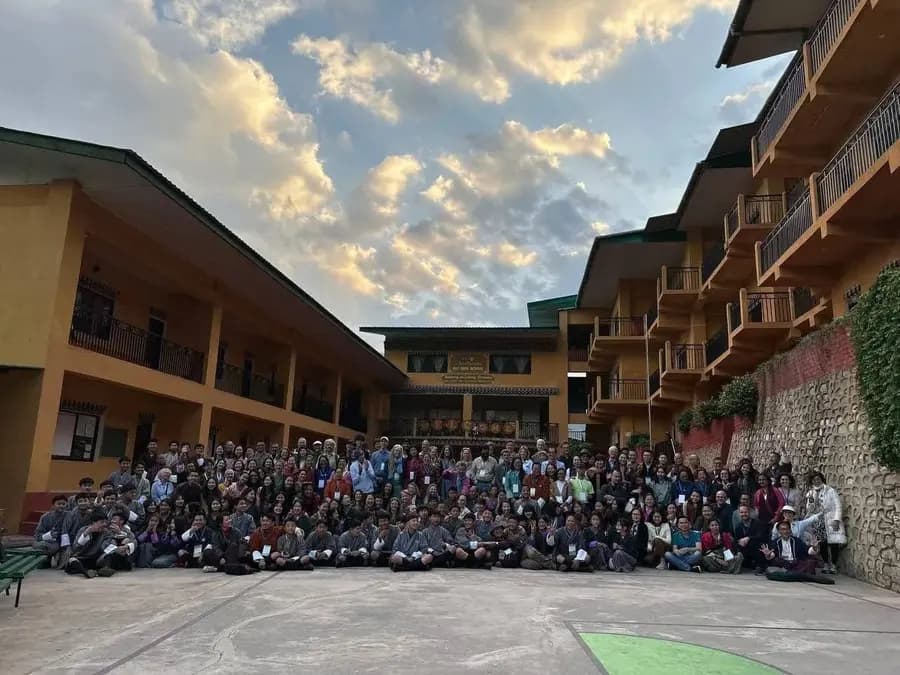
What began at ELC now informs a wider network. Schools across Asia are drawing on what was learned here, and ELC's practice contributes to national guidance issued to schools throughout Bhutan.
In the national picture
Bhutan's National School Health and Wellbeing Strategy, led by the Ministry of Education and Skills Development with the PEMA Secretariat, sets out wellbeing programs for every school in the country. Here is how ELC delivers each of them.
ELC's Founding Principal sits on the Ministry's Joint Steering Committee for Education Reform, and ELC's wellbeing advisor has contributed to the Ministry's working group on the national strategy, so that what is learned in one school can inform guidance for all of them.
Evidence
Wellbeing is easy to claim and harder to evidence. Our School Wellbeing Committee, chaired by the Principal with the Vice Principals and the wellbeing focal, reviews the following through the year, and reports to Thimphu Thromde Sherig. The plan is reviewed at the end of Term 2 and again at the close of the academic year.
| What we watch | How we know | How often |
|---|---|---|
| Learner wellbeing and belonging | Weekly student wellbeing sessions and circles | Weekly |
| Teacher wellbeing | Weekly staff practice, wellbeing sessions, TPDP feedback | Weekly and termly |
| Conflict and bullying | Restorative justice logbook and student practice sheets | On incident |
| Teacher on Duty coverage | Duty roster and reporting | Monthly |
| Family engagement | Attendance and parent feedback | Termly |
| ResLIFE belonging | Weekly house circles and boarder feedback | Weekly |
| Design for Change | Stories of Change completed by each class | End of year |
| Sports participation | Games and sports meet records | Termly |
We are candid about the limits of this. Much of what matters most in a child's inner life does not reduce to a figure, and we would rather hold honest qualitative evidence than manufacture a metric. Wellbeing is not a destination but an ongoing journey with its ups and downs.
I learned that everyone needs wellbeing in their lives. I have changed and grown in a positive way because of wellbeing this year. It is a practice that helps me to calm down, to know my self worth, and to be kind, gentle and loving to myself and to the ones around me.
The best way to understand what this page describes is to stand in the courtyard when the gong rings and watch a whole school stop together. We welcome visits from prospective families at any time in the year.
ELC hosts educators from across Bhutan and beyond who want to see wellbeing practice in a working school rather than read about it. We also contribute to training through the Contentment Foundation Bhutan and our partner institutions. If you are a school considering this work, we would be glad to talk.